

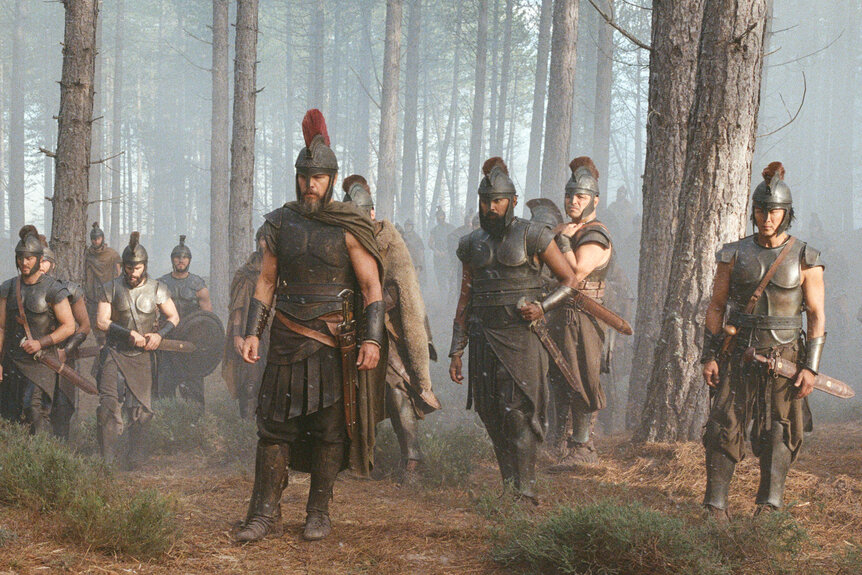
There isn’t much that needs to be said in the introductory paragraph of this review as Christopher Nolan returns to the director’s chair fresh off the Oscar winning runaway success of his last film 2023’s Oppenheimer. An adaptation of Homer’s Ancient Greek epic, The Odyssey follows the saga of Ithaca as its legendary king Odysseus (Matt Damon) has disappeared following his fight in the Trojan War. His wife Penelope (Anne Hathaway) waits for his possible return while fighting off a gang of suitors, led by Antinous (Robert Pattinson), who have overtaken their castle vying for her hand in marriage and thus the kingdom. By her side is their son Telemachus (Tom Holland) who wants to protect his mother and his home while also hoping to find his father. While Telemachus searches, Odysseus recalls his long, adventure filled journey home from war while trying to remember his family and to where he’s trying to return.
Anyone who has received a high school diploma is familiar with the fact that Odysseus endured a long, arduous journey back home to Ithaca in the old tale that bears his name. What makes Nolan’s version of The Odyssey interesting thematically is the psychological reason that subconsciously plays a role in the hero’s delayed return. The film continuously references the cultural more of Zeus’ Law, a guiding moral principles that guides the Greek people in how they interact with others. The law of their most powerful god states that they must treat everyone they encounter well as they may well be a god in disguise. It’s not just a reference to the trickery of the old Greek gods, but a reminder of how to treat others no matter their station in life. While The Odyssey takes us on the familiar stops within Odysseus’ road back, it also provides a new look into the unseen obstacle holding him back; the guilt the soldier feels for the new era he has seemingly ushered in as a result of the brutality that accompanied his cunning strategy to topple Troy and its impenetrable walls.
With his famed Trojan horse, Odysseus presented what seemed to be on its face an offering of peace from the Gods, and Ithaca, to the Trojans but was in reality a deadly instrument of their defeat. And their sacking of Troy, Odysseus’ fellow soldiers engaged in wanton brutality of Trojan warriors and innocent women alike. By the end of the film, the audience is faced with an Odysseus who fears that the violation of Zeus’ Law and the gods themselves has creation a curse of the father for Ithaca; doomed to be punished for his mistake and the sacrilege that accompanied his cunning. It’s a compelling exploration of guilt, both personal and the concept of an inherited form that manages to shine new light on a tale as old as multiple millennia. The patrilineal thread of guilt is touched upon throughout the film not just within Odysseus’ fear of having condemned Ithaca through his wartime actions, but also in the story of Agamemnon’s fate and that of his son, and Telemachus’ burden in trying to find Odysseus while simultaneously preventing Ithaca from falling into the hands of his mother’s suitors. All of these plotlines combine to form a solid thematic heart for the film.
Damon sells Odysseus’ inner conflict in the film’s third act through a monologue outlining his regret, bringing it to the surface. It’s a peek into his subconscious to accompany the western literary foundation of its action and fantasy elements making for a well rounded story that entertains and provokes some thought. It’s a masterful stroke of writing and direction from Nolan that informs the greatness of the film. Hathaway’s performance as Penelope is also laudable in its depiction of the film’s theme of grief, deftly portraying a queen trying to keep a stiff upper lip in order to hold her kingdom together while silently mourning the disappearance of its king and her duty in keeping things upright. Hathaway’s balancing of regal strength, anger at the situation, and sadness comes through in some notable monologues and performances with Holland. Holland himself is equally capable as Telemachus, portraying a young man full of conflict and worry over his father and balancing this with his own coming of age story as he seeks to ascend into a capable leader. The role calls for a range of emotions that Holland is able to act out convincingly, settling into a groove alongside greats like Damon and Hathaway. Every film needs a quality villain and Pattinson’s deliciously slimy turn as Antinous, Penelope’s main suitor, is the perfect foil to Telemachus and Odysseus both. Pattinson captures his duplicity and underlying cowardice well, making him the perfect guy to root against.
Despite the depth in its themes, Nolan is sure to imbue The Odyssey with all of the battles and wonder that have allowed the story to stand the test of time. The film is structured non-linearly, a trademark of Nolan’s at this point, with the narrative portion mostly contained in present-day and Odysseus’ action-packed adventure home told through flashbacks relayed to Calypso, played by Charlize Theron. It’s here we encounter the Cyclops, Sirens, Circe, the Trojan horse, and Odysseus and his men’s battles with them while finding their way home. The sequences contain some of Nolan’s best action set pieces of his career and his first foray into horror territory in his reveal of the Cyclops and Circe. The tension in the Cyclops scenes is palpable, keeping you on the edge of your seat, but is somehow topped just a little later with the depiction of the Ithacan soldiers using the Trojan Horse to infiltrate Troy. The tension watching their plan unfolded is complemented perfectly by a pulsating score that builds alongside their plan, building to a crescendo that arrives at the same time they do. The action scenes are faithful to the material while being fun to watch and magnetic to observe. The scale and production design join the action to create a truly epic cinematic experience.
We are quickly running out of superlatives to say about Christopher Nolan, and spots at the top of his filmography, but the master director has somehow done it again and created another stunning film to count among his best. The Odyssey is simultaneously a crowd pleasing action epic with battle scenes, production design, and practical effects that make it a top notch blockbuster, while also offering something of substance to say that gives the film some weight and a new spin on an ancient story to go alongside its entertainment value. The fantastic cast is almost too deep to name everyone who shone, from Corey Hawkins as the detestable suitor Polybus, to John Leguizamo’s emotional turn as Eumaeus, to Himesh Patel’s perfect supporting role as Odysseus’ second-in-command Eurylochus. Nevertheless Matt Damon’s portrayal of Odysseus is awards worthy and one of the strongest heroes in film in quite some time, Tom Holland proves his potential outside of Spider-Man in his depiction of Telemachus, Anne Hathaway shines as Penelope, and Robert Pattinson continues his display of talent as a foil to them all. The Odyssey hits on all cylinders and becomes yet another Christopher Nolan instant classic.
Image: Universal Pictures


