

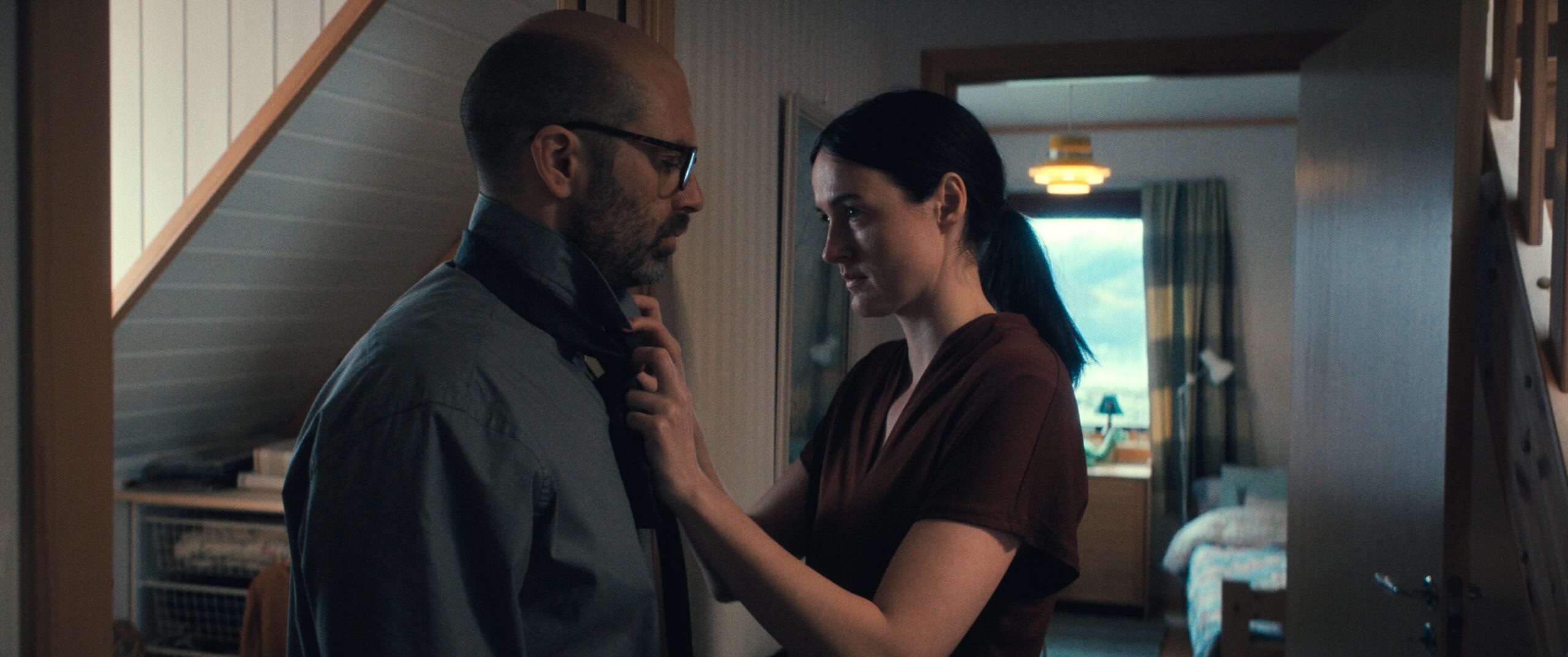
The issue of assimilation by immigrants has been a very hot topic in the world of politics this decade and a new film attempts to explore the nuances. In Fjord, Mihai and Lisbet Gheorghiu (Sebastián Stan and Renate Reinsve), a devout Christian Romanian couple, move to a small town in Norway. As their family settles into their new environment, their adolescent daughter Elia (Vanessa Ceban) shows up at school with some bruises after being disciplined by Mihai and the Gheorghius soon find themselves in the midst of a child protective services investigation and their children taken into custody and placed in foster care. As they fight to clear their names from child abuse allegations, the case becomes an international debate over religious persecution and the limits of state power.
A fjord is a narrow valley, carved by an ancient glacier and now filled with water below sea level. The separation between two steep cliffs serves as a metaphor in this film for the gulf between the religiously observant Gheorghius and the secular, Western European Norway where they now make their home. The clash between the religious observance of the Romanian immigrant family and the Norwegians who are now their neighbors is evident from the very beginning of the film, subtly at first before exploding into the central conflict of the story. The conflict between the state doing all it can to protect the wellbeing of children while accounting for potential bias, conscious or subconscious, against foreign cultures that differ greatly in temperament, views on discipline, and education is the crux of the film and plays out in a tense legal procedural.
Fjord attempts to steer the audience toward an unbiased analysis of this question by flipping the involved parties away from how these questions are normally weighed in reality. The immigrant religious family in the film being European Christians and not non-white Muslims and the government bureaucracy seeking to force their assimilation being a progressive western democracy and not a conservative one. In writing the conflict away from a framing where the audience arrived with preconceived notions, Fjord forces a more honest accounting of the matter at hand. Where does religious freedom end and the interests of protection and justice begin? Are governments that lean heavily toward one sociopolitical philosophy capable of being unbiased when adjudicating a case involving a culture diametrically opposed to what it believes? The film does well in establishing grey when it comes to the answer of what happened between Elia and her parents, what Norway’s procedures are, and how biased the Norwegians are toward the Gheorghius.
Not having the exact answers and leaving the audience to decide for themselves makes for a intriguing thriller that garners sympathy for both sides at times. Stan and Reinsve’s performances as exasperated and defiant parents fighting not just to get their children back but defend their lifestyles and beliefs are effective and empathetic. The anger, confusion, and pain of losing your children, one of which is a newborn, comes through effectively in their acting.
Fjord’s story is a methodical but intellectually tense legal procedural that perfectly balances the material and perspectives of all involved to make a morally grey film that presents no easy answers. The topicality of this subject matter in our own world that currently is dealing with debates over immigration and conflict between recent arrivals in western countries with liberal democratic values only serves to make Fjord more intriguing. Sebastian Stan and Renate Reinsve shine as the parents in this saga, offering emotional performances that inspire empathy but still leave mystery surrounding their characters’ actions. This is a movie that delves into a complex issue in an intriguing way.
Image: Eye Eye Pictures


