

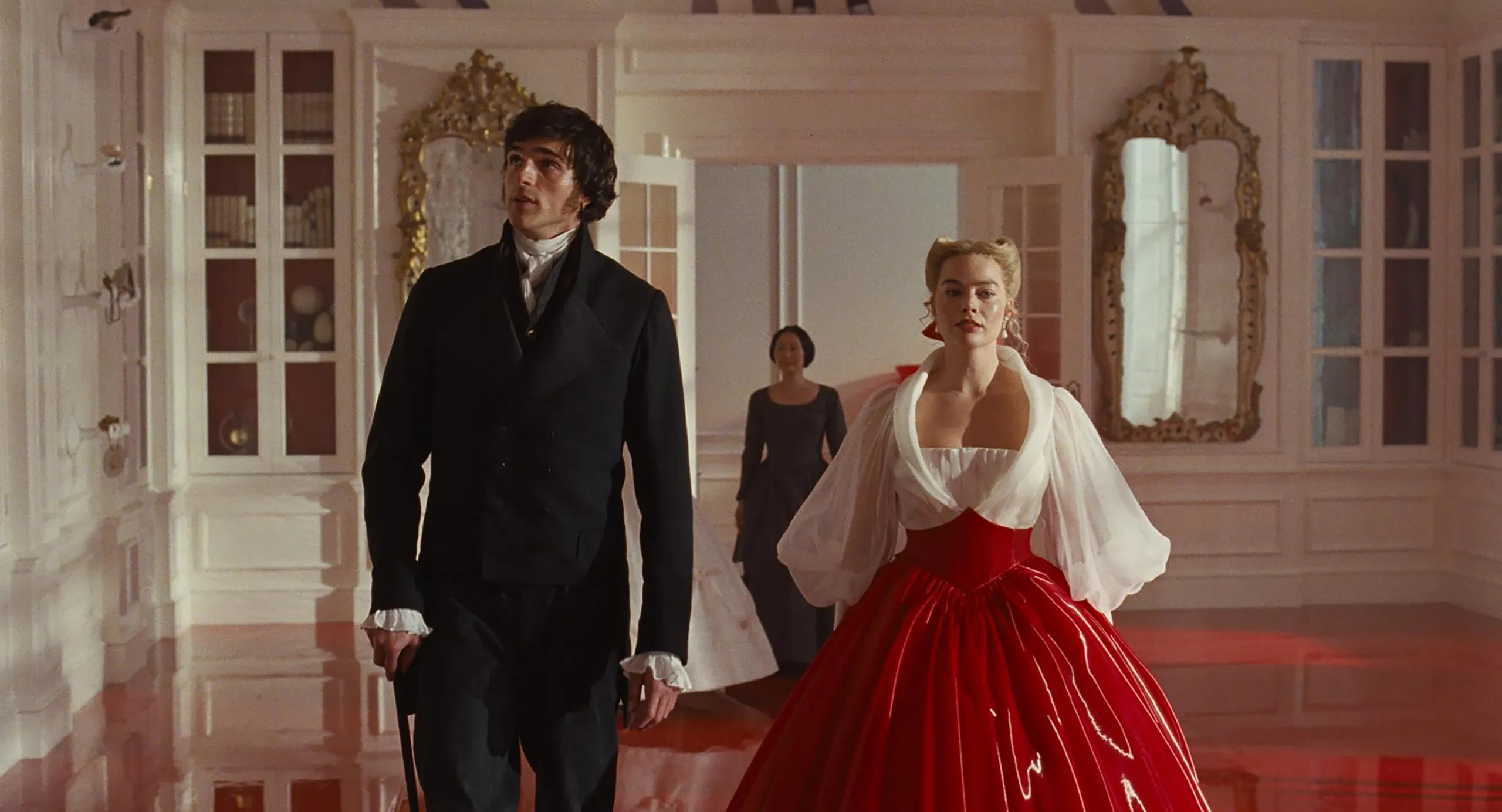
The release of the latest film from writer/director Emerald Fennell has been much talked about. On the one hand, you had the excitement of a new take on Emily Brontë’s landmark 1847 novel Wuthering Heights starring Margot Robbie and Jacob Elordi) complete with a marketing blitz to build buzz. On the other, as more information was shared about film revealing that it would be an interpretation of the original text by Fennell rather than a one-for-one remake, worry and skepticism began to rise regarding what the increasingly polarizing director would do to the beloved story. The moment of truth has finally arrived with the release of the film.
“Wuthering Heights” follows Catherine Earnshaw (Charlotte Mellington/Robbie) who lives in Yorkshire, England on an estate called Wuthering Heights with her alcoholic, gambling addict father Mr. Earnshaw (Martin Clunes). Mr. Earnshaw comes home one day with a young boy he rescued off the streets. After presenting him to be Catherine’s “pet,” she names him Heathcliff (Owen Cooper/Elordi) after her deceased brother. The two grow to be quite close, to the dismay of Catherine’s previous best friend Nelly Dean (Vy Nguyen/Hong Chau), one of the Earnshaws’ servants. As they grow older, Catherine and Heathcliff fall in love, but Heathcliff’s impoverished background makes their marriage impossible and Catherine instead marries neighbor Edgar Linton (Shazad Latif). Heartbroken, Heathcliff leaves Yorkshire but returns a gentleman. Bringing chaos back with him.
The debate on how closely toward the source material a film should tack feels like an eternal one that is destined to reconstitute itself on an annual basis. In many cases, the successes and failures of films have hinged completely on their ability to toe this line, particularly when it comes to diehard, preexisting fan bases for the material. Much has been made of Fennell’s decision to interpret Wuthering Heights through her own lens to the point where the official title of the film includes quotation marks to make the differentiation clear. As someone who is not intimately familiar with Brontë’s beloved classic or characters like Hindley Earnshaw (who has been excised completely) or Isabella Linton, my critical opinion is that Fennell’s version has something to offer in its depiction of love, loss, hedonism, revenge, and jealousy that can stand on its own even if it isn’t what many have come to know this tale for.
From the film’s sadistic opening, Fennell sets the tone for the type of Yorkshire she will be presenting to the audience; one where cruelty is a social norm that flows throughout the culture and thus would obviously affect how the people of the town behave. The gruesome public execution is also the first indication that Fennell’s now auteuristic touch would be present in the film as well with the raw depiction of violence in line with her unflinching style in her previous films like 2023’s Saltburn. Cruelty is something most of “Wuthering Heights’” main players indulge in with those around them as the film progresses, starting with the alcoholic, gambling father Mr. Earnshaw and his treatment of young Heathcliff as well as his servants. His behavior provides a contrast to the adoration young Heathcliff and Catherine have for each other as respites from their home life, which strengthens the depiction of the love affair that grows between them. While the pathway there is different from earlier versions of this story, the love between the two at the center of the story remains and the chemistry between Robbie and Elordi plays no small part in how well it comes across. The two actors portray young people who have grown to love each other well and also capture the struggle presented by social mores surrounding class that keep them apart. It’s the kind of torturous romance that will satisfy the female fans in the audience and made the book so beloved in the first place.
The film’s depiction of how jealousy develops from love lost is also established well, but in a way where the accuracy begins to give way to controversy. Nelly is depicted in this film as jealous of Heathcliff and Catherine’s relationship which has relegated her from a close friend, borderline sister of Catherine, to just the help. It’s a resentment that she carries into adulthood until it boils over and torpedoes Catherine and Heathcliff’s relationship. This differs from the Nelly in the book who isn’t as entrenched in the development of their relationship. As in the novel, Heathcliff in the film becomes mad with jealousy following Catherine’s marriage to Edgar and Elordi again does quality work in depicting a man whose heartbreak manifests as cruelty and abuse. He’s monstrous as a Heathcliff determined to get Catherine’s attention by any means and really sells this aspect of the character.
What Fennell has changed is the identity of the man who drove Heathcliff’s humiliation from a jealous Hindley Earnshaw, who doesn’t exist in this world, to an alcoholic Mr. Earnshaw. If you’re not familiar with the novel, it makes sense in the narrative, but for fans, it represents an abrupt change in the story. For “Wuthering Heights,” making Mr. Earnshaw the source provides some commentary on generational trauma and class stratification as his abuse and alcoholism led to desperation and scarring, both physically and psychologically, for Heathcliff and Catherine, and his treating Heathcliff as a peasant “pet” for Catherine had the downstream effect of making Nelly feel lesser than and like the help which has lasting effects on them all. On its own, the themes are interesting and worthy of discussion if one can get past the difference from the source material.
One thing many will be able to agree on is that Fennell’s flair for gorgeous cinematography and production design has made its way here and the film is all the better for it. From the way the characters are blocked in each frame, to the use of reflection in mirrors to create dynamic shots, to an excellent sequence where Catherine is given a tour of Edgar’s home and her new rooms with a great tracking shot, “Wuthering Heights” is a visual treat with an aesthetic that is made to pop and satisfy those in the audience who love color and period pieces. The score in the film mostly works as well, though some of the songs, which were crafted by pop star Charlie XCX do feel a bit too modern at times and may take some viewers out of the film in spots.
All in all, “Wuthering Heights” stands on its own as a solid romantic drama period piece with two strong main actors in Margot Robbie and Jacob Elordi and a director in Emerald Fennell that puts just enough of her signature touches in the film to give it a somewhat unique feel in certain aspects. If it were judged on this alone, it’d be seen as a solid romance film. The baggage that comes from adapting a classic will make this film polarizing however, as fans expecting a retelling that sticks to Brontë’s vision will have plenty of quibbles regarding Fennell’s choices. Which side of the aisle you fall on is totally up to you.
Image: Warner Bros.


