

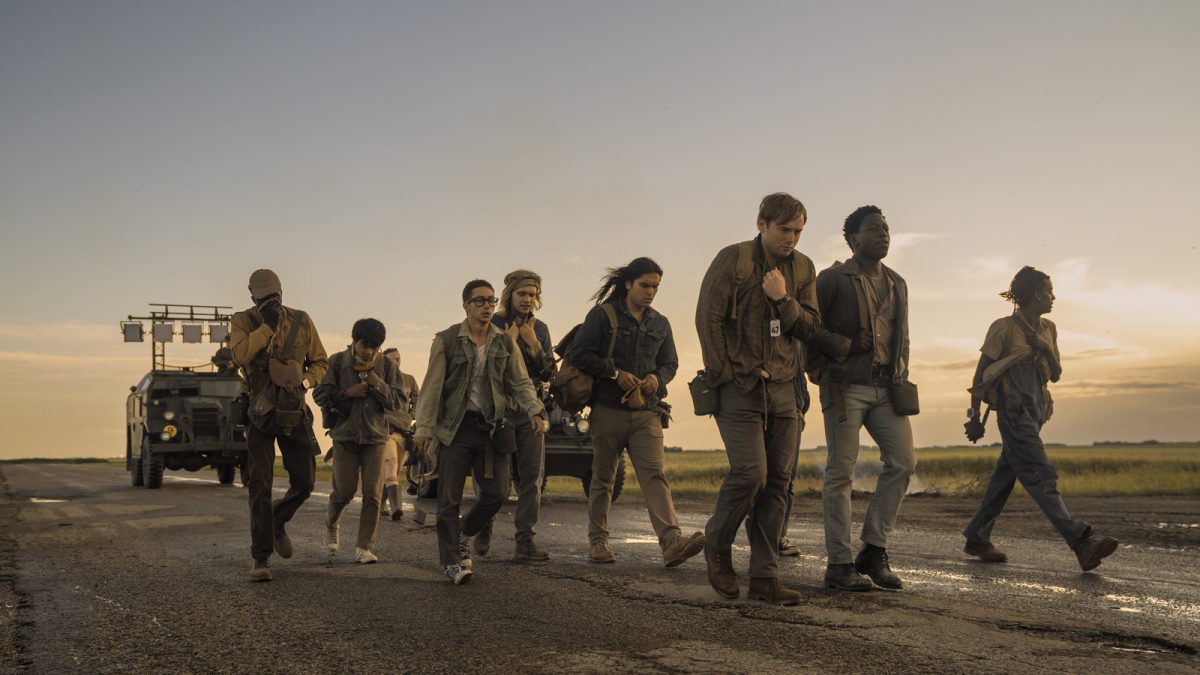
One of Stephen King’s earliest works finally makes it to the big screen in the latest film adaptation of the legendary scribe. In The Long Walk, a group of young male teens who inhabit a dystopian, post-war America volunteer to participate in a grueling, high-stakes contest where they must continuously walk or be shot by a member of their military escort with the winner collecting a large cash prize and one wish that must be granted.
Given its premise, it should be no earthshaking revelation that The Long Walk is in part a film that examines desperation and what that feeling of hopelessness and the drive to change one’s circumstances can drive human beings to do. The America that the characters in this film inhabit is one where no hope for success, freedom, or even sustenance exists for citizens as the country seeks to rebuild itself to its former glory following a catastrophic war. This provides the context that explains why such a brutal, dystopian contest still attracts all of the nation’s able-bodied young men to participate despite the stakes and statistical unlikelihood that they will survive in order to collect the riches at the end of the walk. When all else is hopeless, what other choice do the desperate have? It’s a bleak glimpse into human psychology, an allegory for how the human mind and spirit operate in tandem, and perhaps an answer for why people make the choices that they do in our real lives.
What would you be willing to risk or endure so that your family could have a better life? If you could instantly earn enough money to escape certain poverty and take your family with you, is your own life worth a sacrifice with only one-tenth of a percentage’s chance of succeeding? In a time when even college graduates of previously prestigious and lucrative programs of study like computer science and engineering struggle to find work, all signs point to recession while inflation rages on, and pundits struggle to make sense of rapidly radicalizing young men, The Long Walk posits that tough times with no light at the end of the tunnel lead to tough decisions and hardened men who head down darkened paths.
Another striking and relevant thematic aspect of the film is the sense of camaraderie that slowly develops among the young male characters that aids them in their journey and eventually, their overall paths of self-discovery. The desperate young men, miles away from their families have no one to lean on during this intense trial except for these new strangers with whom all they have in common is a hope for a better life that is strong they’re willing to risk their lives for it. This singular thread slowly draws them together, motivating them to keep one another motivated and fighting for a chance at reaching paradise. Seeing the young men uplift one another and form bonds adds emotionality to the film and another layer of topicality in light of our own society’s aforementioned issue with the socialization of young men. The Long Walk’s story highlights what shared purpose can do for not just young men, but all downtrodden people who need something to believe in and someone to believe in them. In their shared hopes for a better future and the pain in taking the only path there, they found refuge with each other and that togetherness strengthened them as a collective. It’s a needed message in a world that can seem devoid of such a thing.
What sells this aspect of the film is a large ensemble with some of the best chemistry that has been captured onscreen in quite some time. The way that the numerous actors are able to play off of each other and sell the humor, worry, hope, and despair that each participant in the walk feels at various points during the journey is the strongest part of the film and the most important in light of how dialogue heavy it is. The complimentary performances of Cooper Hoffman, David Jonsson, Ben Wang, Garrett Wareing, Charlie Plummer, and Tut Nyuot are reminiscent of large ensembles of the past with many actors all playing off of each other like 12 Angry Men. That’s not to compare the quality of the films themselves, but the way each actor fits their role perfectly to increase the sum of all their parts is similar. Jonsson is the clear standout as the optimistic but tough Peter McVries, a natural leader. Jonsson perfectly captures his contagious optimism and the subtle, just underneath the surface pain that powers his pursuit of the walk’s prize that is slowly revealed onscreen. Hoffman does well as Raymond Garraty, equally displaying well the desperation an impoverished young man would have to improve his life and the life of his loved ones. Although she only appears briefly, Judy Greer makes the most of her emotional appearance as Raymond’s distraught and worried mother. Mark Hamill does well as a foil who operates more so as the human face for the oppressive, dystopian regime with minimal to do except appear as the onscreen antagonist.
While The Long Walk can feel a bit redundant in spots due to it being a film about, well, one long walk, the well written script and absolutely incredible and dynamic performances from its ensemble make this an interesting and relevant watch about desperate people caught in desperate times and what this drives human beings to do. It documents not just the chances people will take, but the resiliency that human beings are capable of and what lies within our souls no matter the dire circumstances we sometimes face. In a film that mostly features people talking, Hoffman and Jonsson put forth strong performances that makes that mostly not boring and compelling, aided by a concept that does well in building a sense of foreboding since things can turn awry at any point and the resulting punishment has heavy stakes. It’s at times intense, funny, and emotional, an intriguing look at the human spirit.
Image: Lionsgate


