

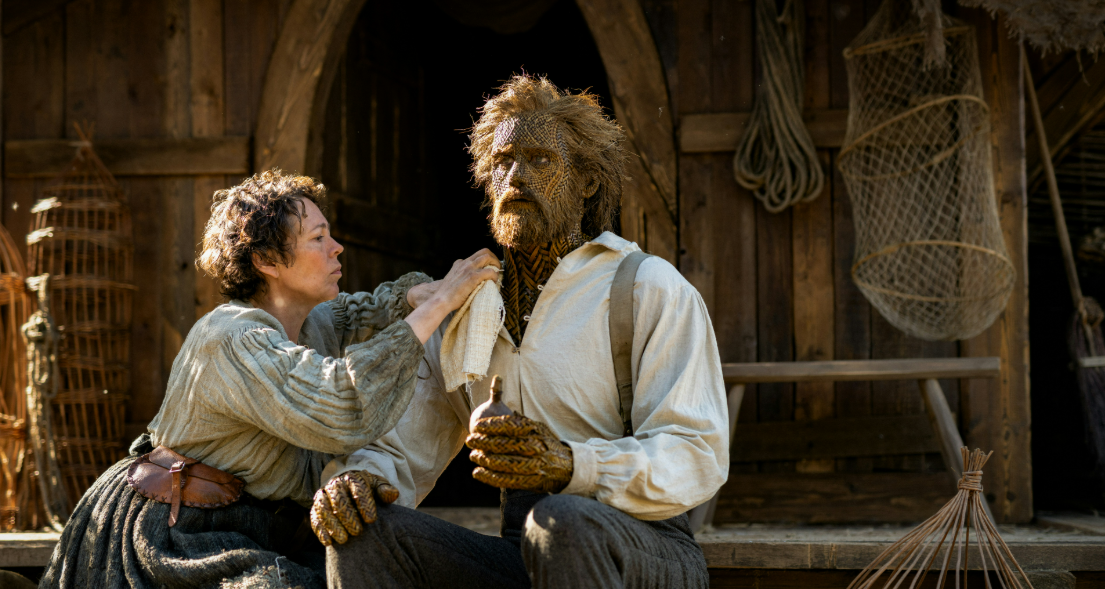
When people first heard that a movie is on the way that features a woman married to a man made of wicker, many were struck by the weirdness of the concept. Was this a creature feature? A comedy about the hijinks of marrying a man made of straw? What it is in actuality turns out to be much more interesting.
Wicker takes us to a small medieval farming town with rigid social hierarchy and culture centered around the formation of families and their place in the village. A single Fisherwoman (Olivia Colman) is ridiculed and ostracized due to her single status and approaches the local Basket Weaver (Peter Dinklage) to make his ultimate creation, her husband. The Basket Weaver creates a Wicker Husband (Alexander Skarsgård) completely devoted to her. The presence of this perfect husband soon creates jealousy amongst the villagers.
The curiosity behind seeing the concept of a man made out of wood behind created to serve as a woman’s husband has certainly driven some of the buzz behind this film leading up to its release, but once the story unfolds, the themes that are being explored are much more grounded and human. The village in which Wicker is set is one in which traditions surrounding marriage and gender roles within the unions are firmly set with expectations to go along with them. As a spinster, the Fisherwoman is made to feel out of place for being a longtime single to go along with the loneliness she truly does experience deep inside. These feelings of isolation, both literally and figuratively in comparison to the other women who are wed is what leads her to have the Basket Weaver make her a husband in the first place.
Of course, the presence of an artificial man in a small, medieval village becomes the talk of the villagers and such a unique entity begins to cause them to question themselves and their own lives. For the villagers, the way in which Wicker Husband is devoted to the Fisherwoman and loves her unconditionally while being a reliable partner and provider cause the village women especially to begin to question their own marriages and the customs that have long ruled the village. The lack of physical touch in one marriage, lack of assistance in the household in another, the lack of words of affection in someone else’s marriage all become more clear and create acrimony in numerous households.
All of these elements are mostly presented in a humorous way, this is after all partly a comedy, but it utilizes its humor to explore the real issue of relationship strife and communication breakdowns as well as the larger societal structure around marital expectations. All of the women put on a performance of sorts for others, whether it’s their husbands or the other wives. Just as the presence of the Wicker Husband serves as a conduit for their rethinking of their lives, Wicker’s story seeks to push the audience to consider what value we put in adhering to what society expects of us as opposed to what we actually desire, particularly when it comes to relationships.
Also notable is the clear commentary the film provides on intrasexual competition within both genders, but especially women. We see the men of the village resent Wicker Husband for the feelings he has stirred within their wives and the resulting increase in expectations of treatment and sexual prowess for all of them, but the love and support that Fisherwoman receives from him stirs jealousy and rage toward her, from the Tailor’s wife (Elizabeth Debicki) in particular, that actually becomes dangerous. It’s an uncomfortable reality not oft explored in modern films, but Wicker handles it in a way that is both realistic and fair. How the film also addresses the Wicker Husband’s lack of autonomy is clever in its breadth. Addressing the elephant in the room surrounding the control that the creator has over the created and how that need for control is the impetus for their creation is not just touched upon in the film’s ending, but also through a subplot involving the Tailor’s Wife’s sister, played by Marli Siu, and a decision she makes while in grief. Creating another living being to fulfill a whole present within yourself is a messy ethical dilemma that can turn ugly depending on how far it is taken. Wicker covers this ground within the flow of its story that feels natural as a result, thought provoking without being preachy or obvious.
The performances in Wicker are just as good as its story with the big name cast performing as well as you’d expect with the less familiar faces keeping up right alongside them. Skarsgård and Colman lead the way with the actor perfectly embodying a synthetic creature, speaking and moving in the way robotic manner that you’d expect. The costume designer that created his practical wicker suit also did an impeccable job of creating a lifelike suit for him to wear that feels believable instead of cartoonish. Colman hits all the right notes as the Fisherwoman and the source for much of the film’s more emotional moments. Her portrayal displays a vulnerability which captures the film’s exploration of the negative emotional effects of the larger societal trends. Debicki shines as her mirror opposite, the detestable and manipulative Tailor’s Wife’s who longs for independence from having to carry the emotional baggage of not just her home, but the entire village, but misdirects her ire toward the Fisherwoman. Debicki portrays this duality perfectly.
Wicker is funny throughout, even sensual at times, while maintaining thematic depth covering how human relationships and rigid social orders can stifle and harm people. The all star cast shines, led by Olivia Colman, Alexander Skarsgård, and Elizabeth Debicki to compliment the material. It’s a weird concept that ultimately works through its exploration of common issues that audiences can relate to and reflect the world around us.
Image: Black Bear Pictures


