

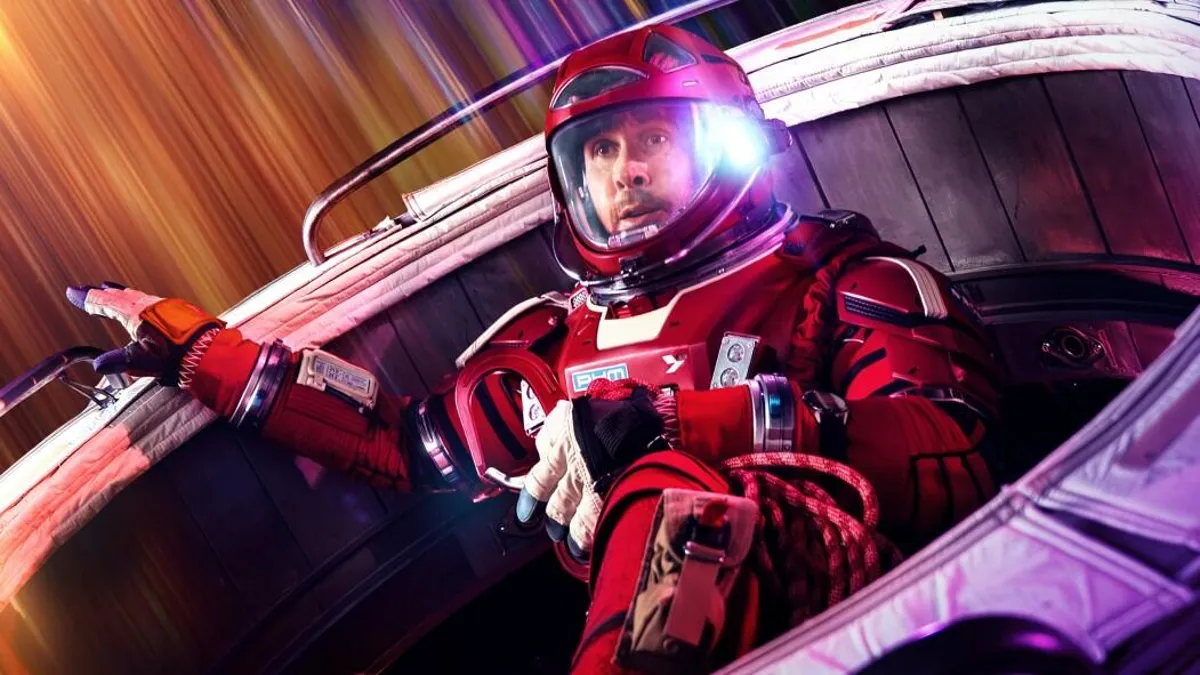
Beloved writer/director duo Phil Lord and Chris Miller return to the big screen with their highly anticipated adaptation of a popular sci-fi novel. The buzz around this film has been steadily rising, can the end result live up to expectations?
Set in the near future, Project Hail Mary takes place on an Earth where scientists observe the Sun dimming, after an amateur astronomer discovers the formation of a dim infrared line from the Sun to Venus dubbed the Petrova line. The dimming of the Sun will cause a catastrophic ice age within thirty years so the world’s governments appoint former European Space Agency administrator Eva Stratt (Sandra Hüller) to lead a task force to solve the problem. Stratt finds elementary school science teacher and former Ryland Grace (Ryan Gosling) and recruits him to help learn more about the alien microbes that make up the Petrova line due to his theory that water may not be essential for life everywhere in the universe; a theory that spurred his ouster in scientific circles. After Grace awakens on a spacecraft with no memory of himself or his mission, he must figure out why he’s there while at the same time learning that humans aren’t the only ones trying to solve the mystery of the Petrova line.
The best science fiction tales are deeply human at their core and Project Hail Mary is no exception. Its story is one built on themes of friendship, bravery, and sacrifice. The relationship between Grace and Rocky perfectly encapsulates the ability of the film to transcend its fantastical and galactic elements and penetrate deeply into the human spirit as the character development and story engender a sense of empathy and caring within the audience for a CGI, non-human character that hasn’t been seen since the introduction of Groot in Marvel Studios’ Guardians of the Galaxy franchise. Make no mistake, the awe of what Lord & Miller have created within this world visually is present in the dynamic of these two characters starting with the first contact scene between Grace and Rocky that is instantly one of sci-fi’s best. The score and the visual effects and scale of Rocky’s grand, alien ship combine for a wondrous spectacle that captures the awe of encountering something alien for the first time.
However, once Grace and Rocky begin to communicate, the technological differences and novelty of interacting with someone non-human makes way for a relationship based on trust, relatability across cultures and species, and ultimately love that are central to the human experience and emotional spectrum that ultimately make good films resonant and unforgettable. As the two work together to save their respective worlds, the sense of urgency and responsibility bond them together and invest the audience in the outcome of their stories and ultimately Project Hail Mary itself. As Grace works to save Earth, reluctantly we learn through a series of non-linear flashbacks that provide context for the present day scenes that make up the rest of the film, the question at the center of his character’s journey is what motivates him to brave what he believes is a suicide mission and sacrifice himself. He has no family and thus, nothing or no one to be selfless for. His colleague advises him to “find someone to be brave for” and Grace learns this lesson through his experience with Rocky, an entity that isn’t even human and understands nothing about Earth. Through this relationship with an alien he learns essential lessons about human emotion. It’s a timely story told in a time where many feel a loss of humanity in the world around them, making the film all the more able to connect emotionally for viewers.
Kudos must also be given to Gosling’s depiction of a scientist who was once resigned to being driven from his profession for apostasy, alone and listless, thrust into the impossible against his will, who regains his sense of belonging and love while learning the meaning of true sacrifice. Grace presents his emotional turmoil in a more subdued fashion rather than through grand displays of emotion and Gosling nails the subtlety of quiet depression that is convincing and empathetic. His ability to slowly and realistically build real chemistry with a puppet that invests the audience in both he and the fictional alien is also superb and a clear display of his acting ability. Building chemistry with a human actor is hard enough and Gosling does it here with an inanimate object in a way that feels natural, real, and convincing.
As impressive as Project Hail Mary is in its storytelling, the cinematography and visual effects just as much. Lord & Miller emphasized their use of practical effects in presenting this sprawling look at outer space and the final results display why they felt the need to highlight their efforts. The interior of Grace’s ship was created practically as were other sets and Rocky the alien himself. CGI was used to create the outer space and animation of Rocky, but green screen was completely eschewed. That the film comes out looking as visually rich and vibrant as it does without the trappings of modern technology makes this an instant contender for next year’s awards circuit. Despite the old school tech, Project Hail Mary looks as current as any CGI fest you can think, if not better. That in and of itself is a feat even without the accompanying fantastic story we see onscreen.
Project Hail Mary enters theaters instantly a sci-fi all-timer. Heartfelt, engrossing, and visually stunning, it’s everything that has made blockbuster films the cornerstone of Hollywood for the past 50 years. Ryan Gosling’s ability to create believable chemistry with a puppet that tugs at the heartstrings and creates investment with the audience makes for one of the best performances of his career. This film is a crowd pleaser sure to connect with many and make a mark for the rest of 2026.
Image: Amazon MGM Studios


