

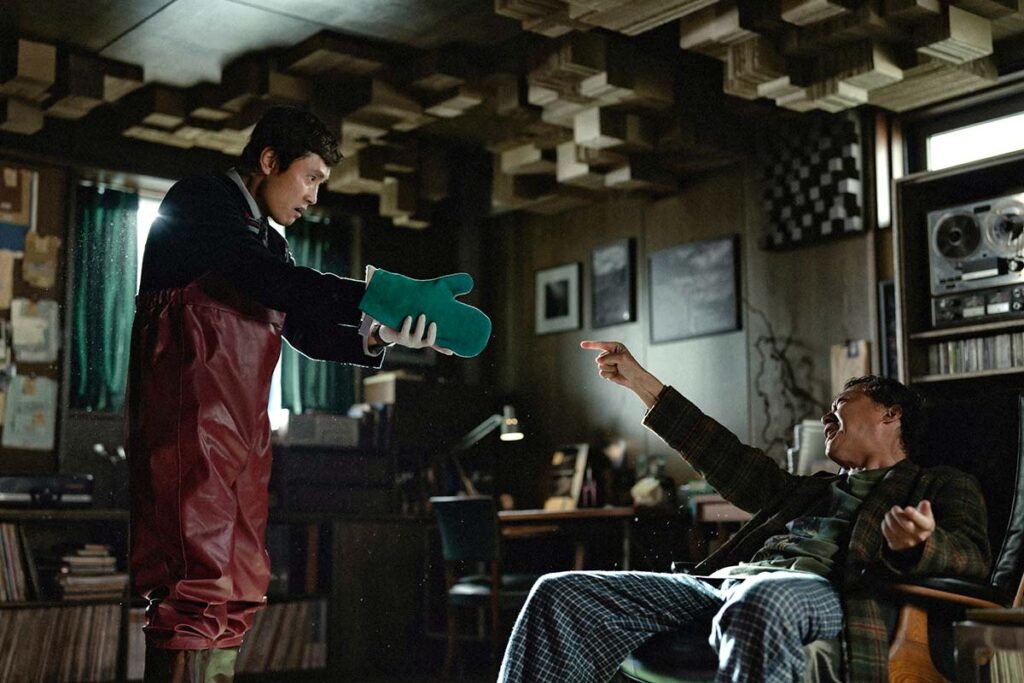
Modern work culture and the future of labor are hot topics in our current moment. The rise of AI and skyrocketing inflation and cost of living in the midst of a recession has many wondering how much more pressure the average worker can take and where many people will be as the struggle to find jobs. Master director Park Chan-wook’s latest film No Other Choice takes a satirical look at a worker in South Korea pushed to the edge of desperation.
In the film, Yoo Man-su (Lee Byung-hun) is abruptly laid off after working for 25 years at the paper making company Solar Paper. After months of underemployment, Min-su and his wife Mi-ri (Son Ye-jin) are forced to sell their home and give their children’s dogs to his parents to care for. Now a desperate man, Man-su decides to go to extreme lengths to eliminate the competition for the job he wants. By eliminating them literally.
What is on display at the center of this film is the cycle of dehumanization within the modern workplace. Solar Paper treated Man-su, a long time employee, horribly in light of its acquisition and restructuring leading to his subsequent desperation where he loses his humanity in the process of losing his material possessions. Even when Man-su reaches the end of his journey and finally gains employment, he never returns to the caring manager that he was at the beginning of the film. Instead, he manages a new company that begins replacing workers with AI and executes their strategy without a care in the world like he had previously when Solar Paper first announced its layoffs; because he now has “no other choice.” That phrase pops up throughout, a through-line on how unfair changes are made and rationalized by companies. It’s an all-encompassing look at the ruthlessness of corporate machinations on both the macro level and the humanistic level with Man-su’s journey both spiritually and through the satirical corporate metaphor of his becoming a killer.
Byung-hun does well in depicting Man-su’s descent into becoming an employment hitman, portraying both his desperation in light of his familial responsibilities, his hesitancy and novice when he must actually carry out his planned hits, and the gradual transformation of this mild-mannered family man into someone calculating enough to kill multiple people for his own benefit. Ye-jin’s arc as the unsuspecting wife who soon suspects something is a valuable contrast to Man-su’s development and interesting to see develop in its own right.
The desperation job seekers feel after a long stretch of employment is a running theme in No Other Choice not just from Man-su, but his targets as well. This is displayed in multiple scenes like one involving Man-su’s target Mr. Goo (Lee Sung-min) who receives a call from Red Pepper Paper and shows a high level of nervousness and anxiety when answering; wanting to ensure everything is right and perfect so that he can finally take advantage of his chance at employment. The premise on which this film is based is meant to be relatable and the way in which Park depicts all characters involved, from Man-su and his family to the executives at the very top covers all aspects of a down job market, uncaring companies, and their ripple effects.
It must also be noted that Park continues to display his technical mastery of the craft the craft of filmmaking, building upon his 2022 instant classic Decision to Leave. His use of reflection as well as the way he and director of photography Kim Woo-hyung place the camera placement are some of the most dynamic visuals in film and the very definition of auteurism. The way in which Park utilizes reflection through glass cell phone screens or shots where he places a camera at the bottom of a beer mug and shoots a character taking a drink from that perspective is unparalleled by any director working today save for perhaps James Cameron. It makes how he films modern technology unique and eye-catching and brings a flair that only adds to his clever writing and topical storytelling.
No Other Choice simply continues Park Chan-wook’s legendary current run behind the camera, providing relevant social commentary in a way that is both thrilling and thought-provoking while providing moments of humor as well. His actors all meet the moment, led by Lee Byung-hun with Son Ye-jin providing a substantial assist. It’s another notch in the director’s belt.
Image: NEON


