

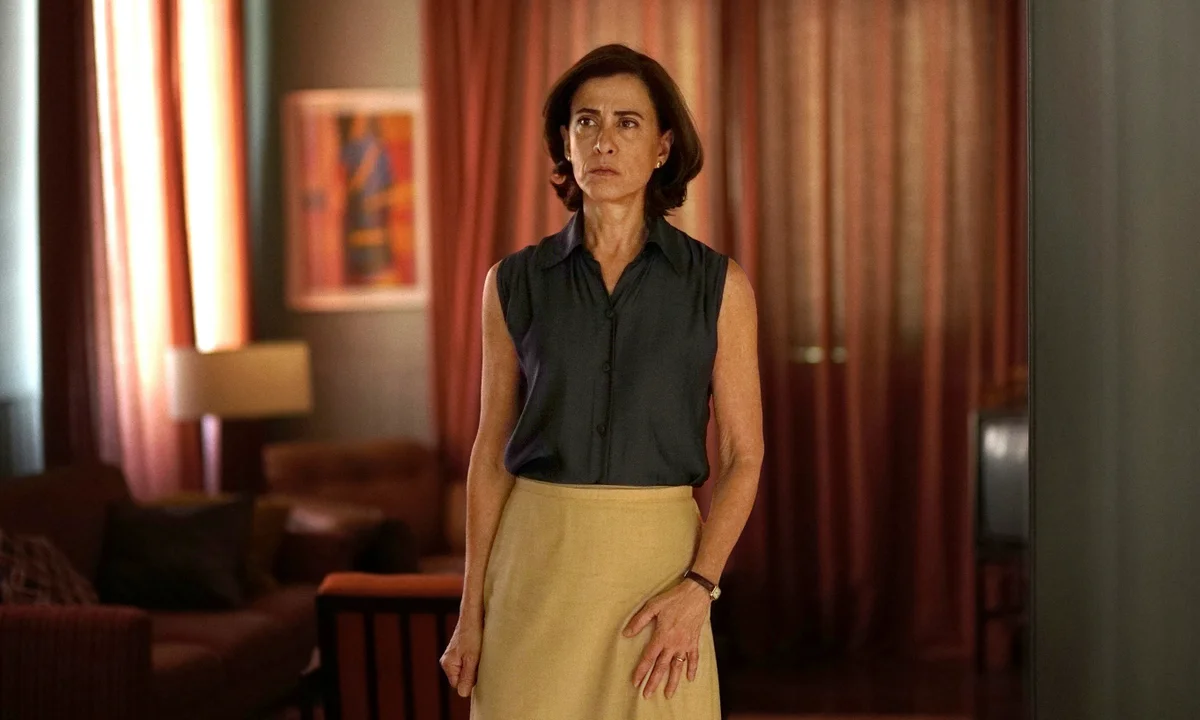
I’m Still Here tells the true story of Eunice Paiva (Fernanda Torres), the wife of a former Brazilian politician Rubens Paiva (Selton Mello) who finds himself a target of the Brazilian military dictatorship of the 1970s. After Ruben is taken by the military and disappears, Eunice begins a lonely battle to learn the truth while trying to keep her family together.
When most people think about grief, they picture the reactions that surface in its immediacy. Overt expressions of pain and loss such as wailing, crying, trembling, or shaking. Anyone who has had the unfortunate experience of coming to terms with grief is aware though it lingers past those initial moments where it is fresh and new, surfacing at the most random and often inopportune times when you least expect it. Maybe while browsing an aisle in the grocery store, a brief time while you’re daydreaming, or maybe a passing glance or experience you shared with a person long gone when it hits you in a powerful wave all at once. It’s this side of the grieving experience that is highlighted in I’m Still Here and reflected in the film’s tone; the quiet, contemplative, lingering side of grief and knowing your life has been irrevocably changed through loss. It makes watching the film more methodical, a character study of what a quiet, determined matriarch looks like while trying to balance her pain and grief with being strong for her family.
As we watch Fernanda move to pick up the pieces of her life, protect her children, and seek answers and justice for her slain husband, the film uses her steady but reserved determination to display how some use internal strength to get through tragedy and find their resolve even as the pain of loss sits with them at all times while doing so. This makes I’m Still Here lean more on an emotional connection with its audience rather than an entertaining one, depending heavily on Torres to communicate her characters emotional state to power the film. She indeed succeeds here, deftly portraying what quiet pain and determination look like; eschewing over the top, grandiose displays for subtlety. It’s a performance that has almost singlehandedly elevated I’m Still Here into the Oscar race and beyond the realm of art house cinephile discussion. The recent reelection of Donald Trump as United States President has also undoubtedly spurred many to draw parallels between Eunice’s struggle against the military dictatorship with current-day opposition to the Trump. Between its topicality and emotional pull, the slow pacing may be less noticeable for those who are more affected by the former two elements in the film. The enjoyment of I’m Still Here will depend on where each individual viewer lands.
Image: Sony Pictures Releasing


