

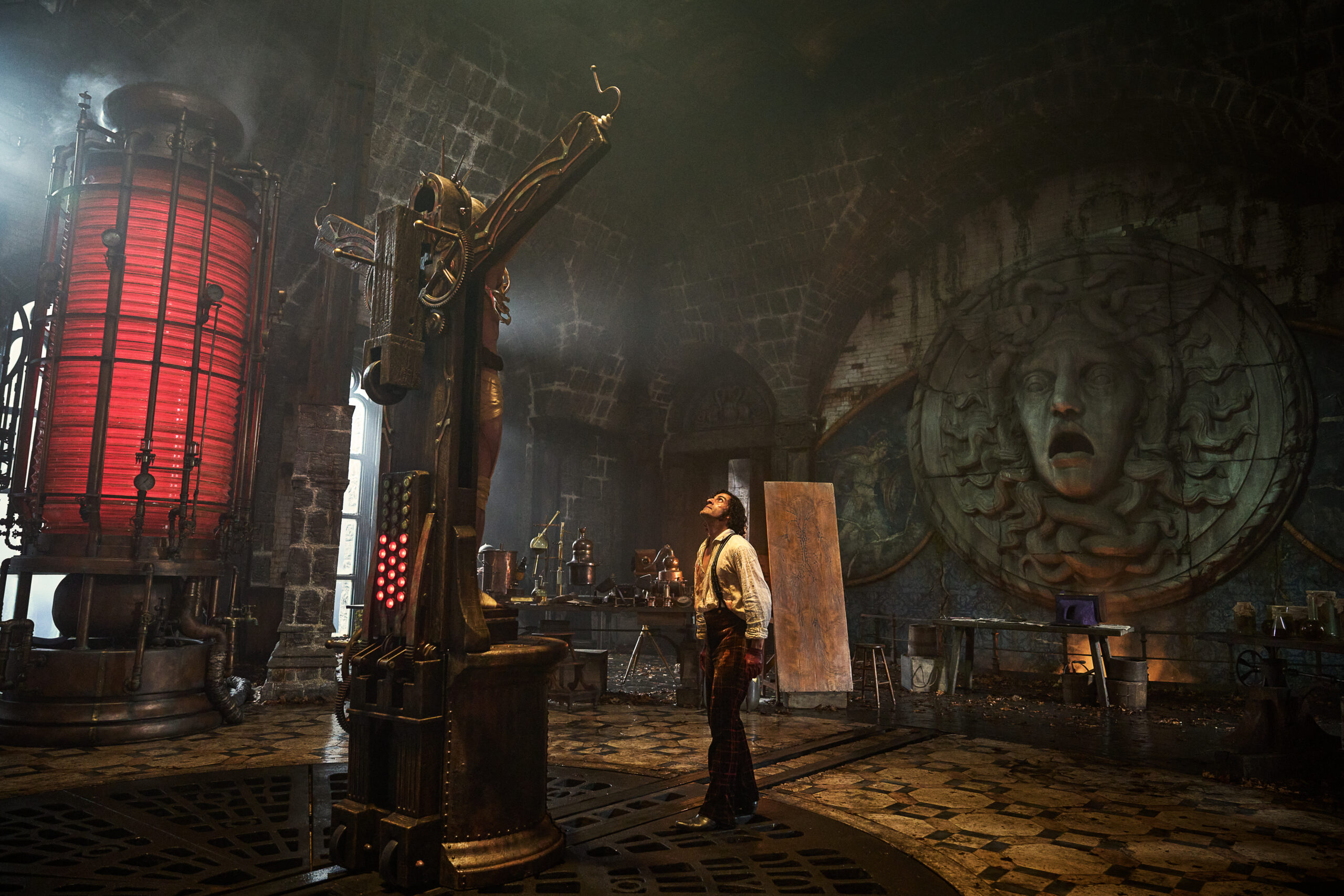
You know the general framework of the story of Frankenstein by now; a brilliant but egotistical scientist Dr. Victor Frankenstein. (Oscar Isaac) conducts an experiment where he brings a monstrous creature to life (Jacob Elordi) in a daring experiment that ultimately leads to the undoing of both the creator and his tragic creation.
Del Toro’s penchant for utilizing fantastical monsters in order to tell deeply human stories is his calling card by now and with Frankenstein, he’s not seeking to reinvent his signature style. This is not a bad thing however as the film presents the legendary creation of the mad scientist in a bold new way in order to explore themes of control over one’s life, trauma, and forgiveness. We know that Dr. Frankenstein’s pursuit of playing God and creating life is a doomed experiment that metaphorically plays with fire until a literal one undoes his mistake however, Del Toro’s take on the story delves much more deeply into the doctor’s psyche and makes clear how morally bankrupt not only project is, but the doctor is himself in order to even want to undertake it.
Del Toro’s penchant splits his version of Frankenstein into two parts, Part One being Victor’s Tale and apart Two being The Creature’s. Del Toro spends much of Part One covering Victor’s tumultuous childhood being reared by his father Leopold (Charles Dance) who was light on love but heavy on discipline and pressure for Victor to follow in his footsteps. As Leopold mistreated both Victor and his mother, but doted on Victor’s younger brother William following their mother’s death, this led Victor to feelings of inadequacy that he would deal with throughout his life, save for when he was working on his science experiments. Del Toro’s take presents Victor’s obsessive and immoral work as a trauma response, one that allows him to feel a measure of control and accomplishment in his life that he could never achieve otherwise. It’s a tale of an abused and neglected child turned adult who never received a healthy response to his past pain and thus never developed a healthy outlet for it either.
Combining the classic story with this examination of a common ill works well due to Del Toro’s writing and Issac’s maniacal portrayal of Dr. Frankenstein that runs the gamut from a brilliant obsessive to a detestable monster to a terrified man who flew too close to the sun. Issac portrays every step in Victor’s actor perfectly, encapsulating his fall from grace and ultimate recompense in the end. He’s at once sympathetic and off-putting, capturing the multifaceted humanness that a man with Victor’s story would have. The second part of the film retelling the tale through the creature’s eyes and narration is a creative touch that provides the film with a bit of originality, delving more deeply into its motivations and humanizing him in a way more in line with Mary Shelley’s novel rather than the films that many in the audience are used to seeing.
Here, we see how the creature deals with his abnormal nature and creation and existence in a world that sees him as grotesque. As in Shelley’s novel, we see the resultant loneliness and anger at what Dr. Frankenstein has cursed him with; a life of solitude. Through the creature, which is a son of sorts, Victor has recreated and passed down the father-son trauma he experienced in his own life. An abuse of a different kind, but mistreatment nonetheless, which gave the creature his own psychological cross to bear. It’s a metaphor for generational familial trauma that is well written and executed onscreen by Del Toro with Elordi displaying the vulnerability of the creature with aplomb, along with its trademark monstrous physicality. The creature’s look must also be noted as the 100 percent practical makeup looks great in its final form alongside the impeccable production design that has now come to be expected from a Guillermo Del Toro film.
Frankenstein mixes new thematic depth with the classic story from the novel to create a film that is engaging to watch and thoughtfully craft. Guillermo Del Toro’s decision to tell the story in two parts from the differing perspectives of the doctor and the creature not only creates a compelling story on the human experience and generational trauma, but provides the film with a steady pace that keeps the audience invested throughout.
Image: Netflix


