

After abruptly retiring eight years ago, the film world was abuzz when legendary three-time Academy Award winner Daniel Day-Lewis announced that he’d be returning to movie theaters to star in a film he co-wrote with his son Ronan who’d also be making his debut behind the camera as director. Does the elder Day-Lewis’ return live up to the hype?
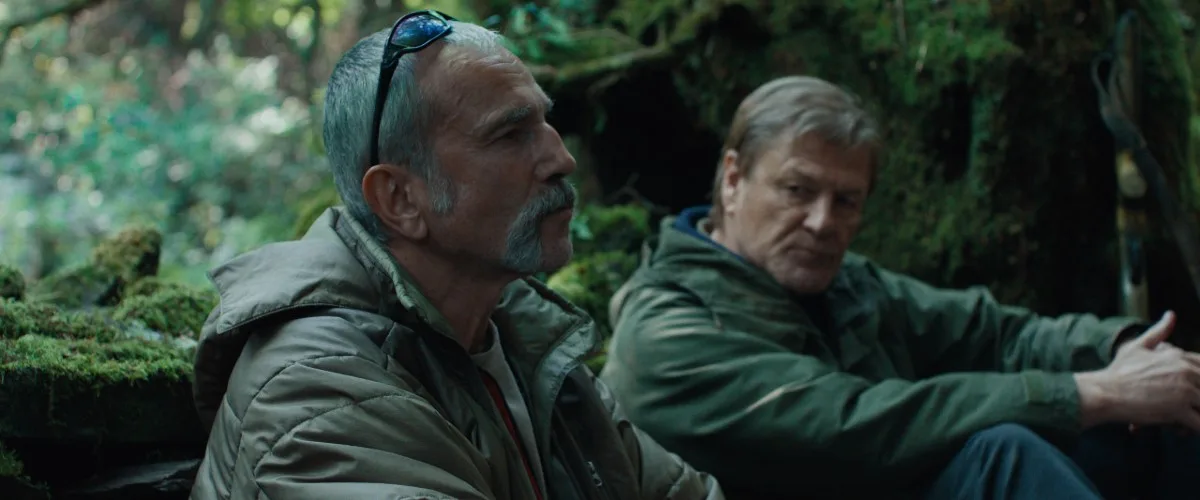
Ray Stoker (Daniel Day-Lewis) lives in a cabin deep in the woods of Northern England as a recluse, partly due to a tragic crime from his past and partly due to the resulting trauma from a troubled life. His withdrawal from his family is beginning to take its toll on his son Brian (Samuel Bottomley), who is in desperate need of paternal guidance. Ray’s brother Jem (Sean Bean) seeks out his brother to return to his son at the behest of the mother Nessa (Samantha Morton). The brothers’ reunification results in hidden secrets and long-buried resentments coming to the surface.
Anemone is a psychological study on the effects of trauma on multiple generations of a family, more so than a sweeping story and narrative. The film’s aesthetic is established from the onset as the first 15 minutes includes approximately two complete sentences while the rest of the time is spent with establishing shots of the Northern English countryside and the camera lingering and slowly pushing in on the characters as they sit silently in contemplation. The first quarter of the film is slow and methodical as it takes you into the relationship between Ray and Jem and their complicated family history, slowly unveiling what they’ve both experienced and what Ray has gone through individually to make him so reclusive. Despite its pace, the substance is enticing enough to not lose you at first.
Anemone does eventually become a bit monotonous in tone and theme. At a certain point, the audience becomes fully aware of Ray’s having had a tough life and one more tragic story is more redundant than revelatory. The juxtaposition between his pain and the pain he has inflicted upon his son as a result of his response to his hurt livens things up slightly, but not enough to create an entirely new feel for a film that needs it the longer it goes on. The dynamic between Ray and Brian calls to mind Satyajit Ray’s 1959 classic bookend to his legendary Apu trilogy Apur Sansar where we also witness a father’s trauma cause him to withdraw from his son, but where the two diverge greatly is this modern update and its characters are much less engaging.
Even the much ballyhooed return of Day-Lewis the elder to the big screen doesn’t result in enough oomph to elevate the material. He is a highly skilled performer of course, but what he has to work with doesn’t contain enough heft for him to dazzle as is expected from him. The same can be said for his supporting cast who while capable and competent, don’t make this film any more engaging than it is.
Visually, Ronan Day-Lewis shows great promise as a director, but as a writer and storyteller he needs a few more bites at the apple to fully hone his talent. Anemone is a film that made me ponder, what is the difference between a movie being slow and plodding and quiet and contemplative. Perhaps the only difference is whether or not the viewer is sufficiently entertained and drawn into the story being told onscreen, and with this film, that just wasn’t the case.
Image: Focus Features


